NDA government: "Six MLAs, one minister" formula! Which party will receive how many ministerial positions in the new NDA government in Bihar—read the full list.
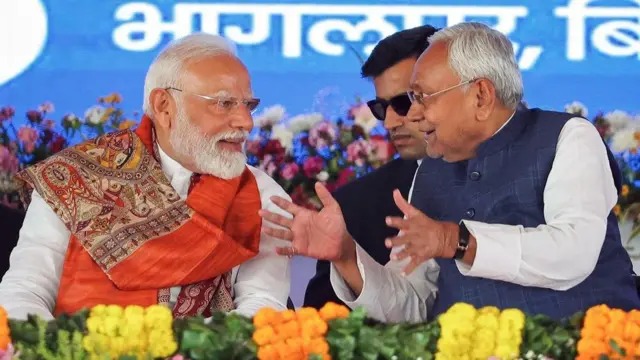
Patna: NDA government: The path to the formation of an NDA government in Bihar has been cleared. Having secured more than 122 of the 243 seats, the alliance is now moving forward to form a new government through the constitutional process. Nitish Kumar is set to take power as Chief Minister once again, but this requires several steps.
First, the Election Commission announces the results of the assembly elections. The coalition that surpasses the majority mark stakes a claim to form the government before the governor.
All NDA parties convene meetings of their respective legislative parties.
These meetings result in two major decisions:
-
electing the leader of the legislative party
-
Consensus on the alliance's chief ministerial candidate
After this, all the MLAs are made to sign the letter of support, which is shown to the Governor.
This was decided in the meeting between Amit Shah and Nitish Kumar in Delhi—
-
JDU: 14 ministers
-
BJP: 15–16 ministers
-
LJP (Ram Vilas): 3 ministers
-
We (Manjhi): 1 minister
-
RLJP (Kushwaha): 1 minister
At this meeting in Patna, JDU MLAs proposed Nitish Kumar's name, which was supported by MLAs from the BJP, LJP, HAM, and RLJP.
Upon passing this proposal, Nitish Kumar became the official candidate for the post of Chief Minister under Article 164(1) of the Constitution.
Nitish Kumar meets the Governor and hands over three documents—
-
Proposal for a meeting of the legislative party
-
Coalition support letter
-
Full list of MLAs (Proof of majority)
The oath is taken in accordance with the Third Schedule of the Constitution.
Two types of oaths are taken:
-
oath of secrecy
-
oath of duty
The Chief Minister is the first to be sworn in, followed by all the ministers in turn. Typically, 20–25 ministers are sworn in first, with the rest following later.
After the swearing-in, the Chief Minister assigns portfolios to his ministers.
This decision is entirely based on a consensus between the Chief Minister and the coalition.
This list then receives the Governor's approval.
A special session of the Assembly is convened within 10–15 days of being sworn in.
The Chief Minister introduces a motion of confidence, and the MLAs vote.
If the motion is passed, the government becomes fully constitutionally legitimate.
The first cabinet meeting takes preliminary decisions, and the Governor issues a notification of the new Council of Ministers.
This notification is considered the official beginning of the new government.
.jpeg "A New Milestone in Good Governance : CM Helpline Becomes the Voice of the People, Over 92,000 Complaints Registered and More Than 42,000 Grievances Resolved in Just One Month,48 Government Departments on a Single Platform; Raipur Leads Among Districts, Energy Department Tops in Grievance Redressal")