Tribal Pride Day Celebrations 2025 - President visits stalls showcasing tribal culture and crafts
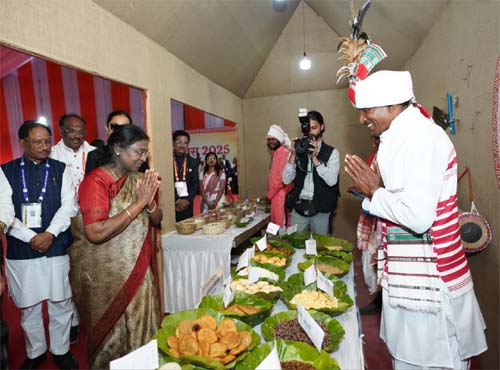
Raipur. President Smt. Draupadi Murmu attended the programme organised on November 20 at the PG College Ground in Surguja district to mark Tribal Pride Day 2025 as the chief guest. Governor Ramen Deka, Chief Minister Vishnudev Sai, Minister of State for Tribal Affairs, Government of India, Durga Das Uikey, Minister of State for Housing and Urban Affairs, Government of India, Tokhan Sahu, Minister of Tribal Development, Agriculture Development and Farmers Welfare, Ramvichar Netam, Minister in-charge of Surguja district and Finance and Commercial Taxes, Om Prakash Chaudhary, Tourism, Culture and Religious Endowments, Rajesh Agrawal, Forest and Climate Change, Transport, Cooperation and Parliamentary Affairs Minister Kedar Kashyap, Public Health and Family Welfare, Medical Education, Backward Classes and Minority Development 20-Point Programme Implementation Minister Shyam Bihari Jaiswal, Women and Child Development and Social Welfare Department Minister Smt. Laxmi Rajwade, Surguja MP Chintamani Maharaj, North Raipur MLA Purandar Mishra, Jagdalpur MLA Kiran Singh Dev, Ambikapur Mayor Smt. Manjusha Bhagat were also present at the programme. Exhibitions were set up at the venue showcasing tribal culture, folk arts and crafts, jewelry and clothing, rituals, cuisine, musical instruments, herbs, etc. President Murmu visited the exhibitions.

The program involved worshipping the deities at the Devgudi, the traditional Akhara site and the center of tribal religious faith. The
participants observed a symbolically constructed model of the traditional Akhara site and the Devgudi, the main religious center of tribal villages. Akharas are cultural sites of the tribal people inhabiting the Surguja region of Chhattisgarh state, located in the center or at crossroads of villages, often surrounded by clusters of shady trees. On various folk festivals, such as Karma, Mahadev Bair, Teeja Aathe, Jivatiya, Sohrai, Dasai, and Phagwa, men and women gather together to celebrate by singing folk songs and dancing to the beats of traditional musical instruments. Tribal community members performed traditional dances at the exhibition. Devgudi, the main religious center of tribal villages, is also known by various regional names in the state, such as Devala Devvalla, Mandir, Shitala, and Sarna. The Devgudi houses rural deities such as Budhadev, Budhidai, Shitala, Sarnadev, Dehwarin, and Mahadev. On various folk festivals, tribal people gather together to perform pujas under the guidance of the village Baiga, praying for the happiness, peace, and prosperity of the village.
A model of the traditional tribal dwellings of Chhattisgarh was constructed at the venue. The President also inspected the model. Tribal dwellings are constructed of mud and wood, consisting
of one or two rooms and a veranda (parchai) in front of the main room. The roofs of the houses are clad in sloping tiles. One room is used as the kitchen, where kitchen utensils and household items are stored, while the other room is used as a bedroom. The veranda (parchai) houses other household items such as mortars, pestles, mortars, and pestles.
An exhibition of ornaments worn by tribal people during various folk festivals and events was held. Kalinder Ram presented the President with a Pairi and a Gamchha.
An exhibition of traditional ornaments from the state was held during this period. President Draupadi Murmu visited the exhibition and inquired about the ornaments. Mr. Kalinder Ram presented the President with a Pairi and a Gamchha, which the President accepted with warmth. Mr. Kalinder Ram informed the President that traditional ornaments are made of gilt, copper, silver, and gold, and are worn during various folk festivals. Displays included the Hasuli (necklace), Bahuta (armband), Ainthi (wristband), a Chandwa (neckpiece) with a rupee (rupee) around the neck, a Kamarband (waistband), Pairi (foot rings), Toe rings, Thoth (earrings), and the Chuchhiya (Phuli) worn in the nose.

The exhibition showcased
instruments played by tribal people for entertainment during folk festivals. The President observed these instruments. The tribal people living in the state play stringed instruments, percussion instruments, ghan instruments, and wind instruments for excitement. Their melodious sounds are a sight to behold during festive occasions. There are many such instruments whose sounds can resonate for miles, inspiring people to dance spontaneously. In the Surguja and Bastar regions, the sounds of these instruments can be heard continuously for months. It is because of these instruments that the rich cultural heritage of the tribes remains alive. Instruments played by the tribes of the Surguja region during various folk festivals, including the mandar, dhol, cymbals, majira, tamboura, sarangi, khanjari, flute, chaurasi, and paijan, were on display.
Herbs used for treatment by tribal communities were displayed.
An exhibition held at the venue showcased herbs used by tribal communities in the state to treat physical ailments. The exhibition showcased herbs like Ashwagandha, Kulanjan, Mulethi, Safed Musli, Giloy, Lal Jhimti, Arjun bark, Pisiya, Bhuichampa, Gokharu, Kutaj bark, Gudman leaves, Viraita, Rohine bark, Balamkhira, Harra and Behada large tamarind seeds, Hadsingar, Akarkara, Chiraigodi, Shilajit, and Balraj. They live in forests, hills, valleys, and lowlands. Their habitats are home to a variety of medicinal plants, tubers, roots, and vines. In case of physical ailments, tribal people seek treatment from these wild herbs. Vaidyas, Baigas, Guniyas, and Hathjods, the tribal community, are hereditary practitioners of treating people.
Traditional dishes and tubers
An exhibition of dishes prepared by tribal communities on festivals and other occasions was organised. Various types of roti, chutney, kohri (bari), laddu etc. were displayed here. Tribal women prepare dishes from the materials provided by nature and collect various types of tubers, fruits, flowers etc. from the forests and use them as food. During this, Kanda-Pitharu Kanda, Dang Kanda, Nakwa (Churka) Kanda, Sakhain Kanda etc. were displayed.


.jpeg "A New Milestone in Good Governance : CM Helpline Becomes the Voice of the People, Over 92,000 Complaints Registered and More Than 42,000 Grievances Resolved in Just One Month,48 Government Departments on a Single Platform; Raipur Leads Among Districts, Energy Department Tops in Grievance Redressal")