Former IAS Anil Tuteja did not get relief from the Supreme Court, refused to grant bail in all the cases simultaneously.

Delhi. The Supreme Court has rejected a petition filed by jailed former IAS officer Anil Tuteja, seeking a stay on filing new FIRs against him and simultaneous bail in all pending cases. The Supreme Court stated that he was among the officers close to power and enjoyed power for years. This is a case of public funds being diverted from private hands. He must follow the legal process.
Former IAS officer Anil Tuteja held sway in the state during the Congress government. He is accused in various cases, including the excise scam, the DMAF scam, the NAN scam, the custom milling scam, and the coal scam. He recently received bail from the High Court in one case. He filed a petition in the Supreme Court seeking simultaneous bail in all the cases, directing investigating agencies to conduct investigations in all cases simultaneously and grant him bail until the trial is complete, and also seeking a moratorium on filing new cases.
His case was heard on Monday by a division bench of Chief Justice Surya Kant and Justice Jaymalya Bagchi. Advocate Shoeb Alam appeared on behalf of Anil Tuteja. He argued that investigating agencies have shown a unique ability to arrest him in another case when he was close to getting bail in one case. The court was informed that Tuteja has been in jail since April 2024 and has voluntarily submitted to continuous custodial interrogation by the Chhattisgarh EOW and ED.
Tuteja's lawyer alleged that his right to personal liberty is being violated by the Chhattisgarh government and the Enforcement Directorate detaining him in a new case every time he is granted bail in a pending case. He should not be arrested in one case just to keep him behind bars. The lawyer argued that he has been in jail for the last 20 months after the Supreme Court cancelled his bail and that he cannot be taken on remand in other cases while he is already in custody. He should be interrogated in all the cases instead of waiting for his release on bail. The same pattern is visible in all these cases.
After hearing the arguments, the court said, "This case is not politically motivated. You are a bureaucrat who has enjoyed power for so many years. This is an issue of public funds going into private hands. If you are involved, you must follow the judicial process." The bench said, "Your argument is emotionally valid, but not legally valid. From a legal perspective, your argument cannot be accepted because when the agency itself is not prepared to arrest you, how can we enforce your arrest?"
The CJI's bench stated that the court granted bail in all cases where discretion was exercised, but it cannot make a mandatory order granting bail in all current and future cases. However, the Supreme Court stated that if he fears arrest, he may seek post-arrest bail or further bail. It also directed that if he files a bail petition within a week, the High Court must decide on it on a priority basis within two to four weeks.











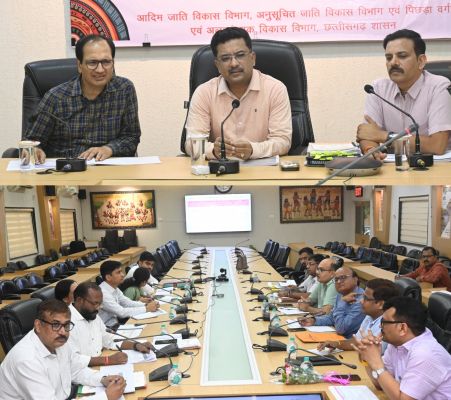
.jpeg "A New Milestone in Good Governance : CM Helpline Becomes the Voice of the People, Over 92,000 Complaints Registered and More Than 42,000 Grievances Resolved in Just One Month,48 Government Departments on a Single Platform; Raipur Leads Among Districts, Energy Department Tops in Grievance Redressal")