Special Article: Folk Festival of Chhattisgarh: Hareli Tihar
Chhattisgarhi culture has a rich tradition of folk festivals, reflecting a deep respect for nature, agriculture, and animals. Hareli Tihar is the foremost and most prominent of these festivals. Celebrated on the new moon day of the month of Sawan (Hariyali Amavasya), this festival symbolizes Chhattisgarh's folk life, agricultural traditions, and love for the environment. Chhattisgarh is known not only for its nature but also for its rich folk culture and traditions.
Chhattisgarh's folk life is rife with festivals and celebrations. Each month, a festival or another captivates the public consciousness. These festivals provide opportunities for joy and happiness, while also providing opportunities for play and entertainment. This verdant nature is fully ingrained in Chhattisgarh's folk life. Whether it's Hareli, Bhojali, Jwara, or Basant Panchami, all festivals reflect the captivating and unparalleled beauty of nature. In this beauty, the joy and enthusiasm of all four stages of life is scattered in various colours.

Perhaps the green of Hareli brings a greater sense of natural greenery to our traditions, our rituals, and our folk life. It is our wish that this green of Hareli spreads and flourishes in everyone's lives. It is also our wish that our sporting traditions remain alive, beyond the glare of materialism, so that the villagers connected to the soil remain physically and mentally strong. May the sweet fragrance of the soil continue to waft through our folk songs, and may this uninterrupted flow of sporting traditions continue to flow.

1. Meaning and significance of the word Hareli
'Hareli' is derived from the word 'greenery'. Farmers celebrate this festival with great enthusiasm in the month of Sawan when lush crops and greenery start blooming in the fields and plains all around. It is considered the first festival of Chhattisgarh, from where the series of major folk festivals of the state begins.
2. Worship of agricultural equipment and livestock
Hareli day is mainly a day to thank the farmers and the means related to agriculture:
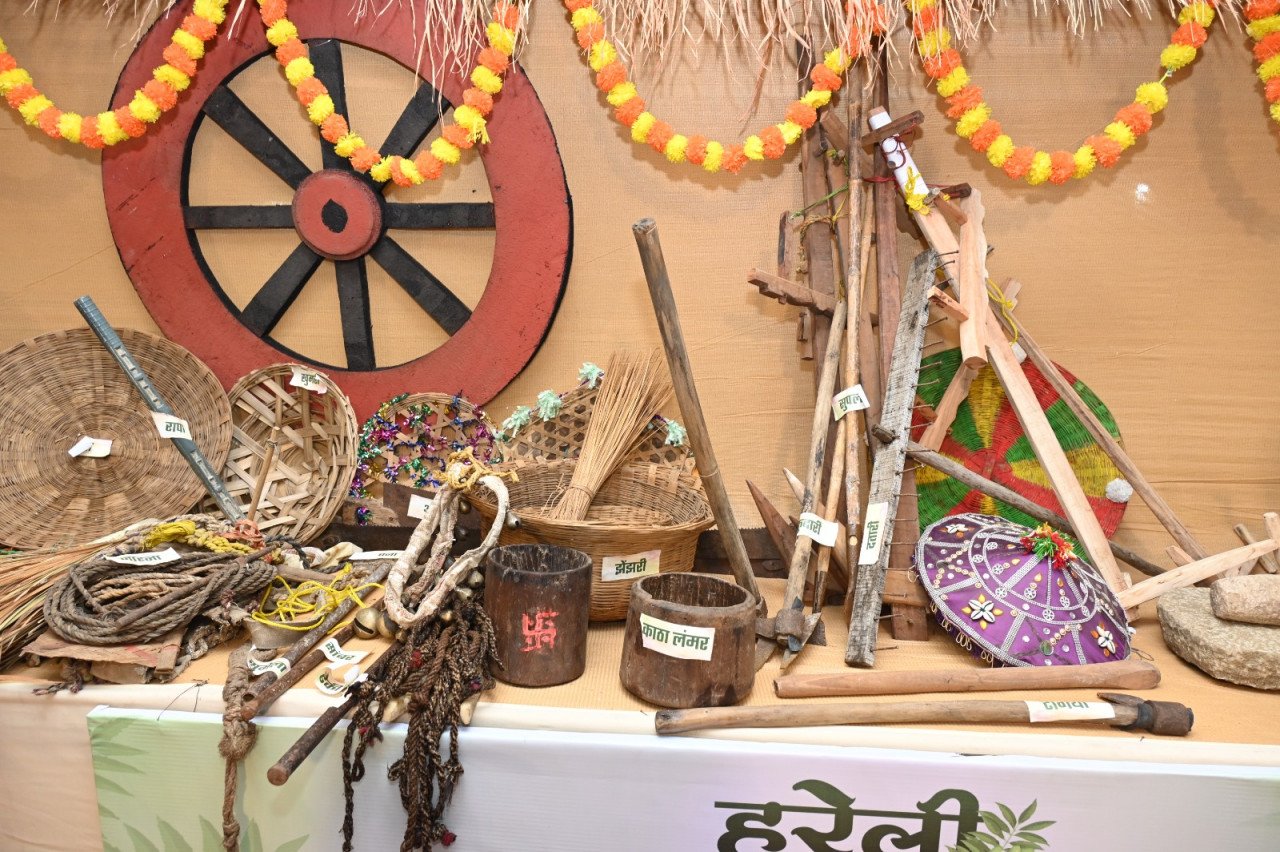
• Worship of agricultural equipment:- Hareli is deeply rooted in the agricultural heritage of the Chhattisgarh region. Apart from being a festival, it is also a spiritual offering. For the people, after worshipping nature, rain and completing their agricultural work, the farmers wash their tools, plough, shovel, spade, pickaxe, pot, bindhna, axe, hammer, saw, asiya, pestle, knife, hoe etc. and decorate them on a seat of clean soil (murmi). The farmers and their women place puja materials on them, apply the washed rice flour on them, offer sandalwood, flowers, incense sticks, lamps and cheela roti, offer a coconut and pray with great emotion - 'O Lord of the plough in the form of Balarama, the symbol of immense power, you adorned the mother in the form of a shoulder and helped us in serving her. As soon as the agricultural work was done, greenery spread all around. Thank you a million times for this. Your work is done, rest in peace. We have caused you a lot of trouble and made you work, please forgive us. May your mercy always remain upon us, similarly, while requesting other tools as per the work, we worship the Gedi and pray for the strength of the body and protection of the feet.

• Livestock Respect: Livestock plays a vital role in farmers' economies. In India, farmers practice a mixed farming system, combining crops and livestock. A large number of people in Chhattisgarh rely on agriculture for their livelihoods due to their low education and unskilled skills. Bulls are the backbone of Chhattisgarh's agriculture. Farmers, especially marginal and small farmers, rely on bulls for plowing, hauling, and transporting both produce and inputs.
• Cows and bulls, true companions of farming, receive special care. They are bathed, aarti is performed, and fed 'Gahunta' (a nutritious mixture of flour, salt, and herbs) to keep them disease-free. Herbal medicines are taken to the cowshed and the medicine is mixed with salt, rice, or wheat balls in castor and khamahar leaves and fed to the animals. Castor and khamahar leaves are medicinal herbs that cure airborne diseases. Salt acts as a stimulant, and rice or wheat makes the medicine more effective. This helps keep livestock healthy, a form of vaccination.
3. Traditions and customs

• The Joy of Riding the Gidi: The Gidi holds great significance during this festival. Thick bamboo poles and bamboo poles are tied tightly in a special way. Examples of the Gidi are found in the Puranas. Balram and Krishna used to ride the Gidi with their friends. This is illustrated in the Krishna Leela episode. Games have also been organized, including Gidi races, watering, standing on one leg, and jumping on one leg, among others. This tradition, which began as a means of navigating muddy and water-logged roads during the rainy season, has now become a fun sport.
• Organizing Various Competitions: Coconut throwing competitions are also held in villages and cities during Hareli. After morning prayers, groups of young people gather at village squares and organize coconut throwing competitions. This coconut-winning and losing competition continues late into the night. Gidi races are organized in every village. Kho-kho, Phugdi, Billas, Atti-Patti, and Danda Pachranga are all being organized. Whether it's the village cowshed or the school grounds, or the road outside the village or the square, everyone is dressed in colorful attire.
• Rituals for Remedies and Protection: According to tradition, neem leaves are tied to the main doors of homes on this day to protect the village from evil eyes and diseases. Blacksmiths fix neem branches and iron nails on the door frames of houses. Local belief holds that this protects the home from evil forces and diseases. This practice is inspired by the known medicinal properties of neem and its role in traditional village health beliefs.
• Dishes Prepared for Hareli Tihar: Traditional dishes like jaggery cheela, aairsa, chauseela, and bobra are primarily prepared and distributed. Traditional Chhattisgarhi dishes like Gulgula Bhajiya, Gudha Cheela, Sohari, Bada, Thethri, Khurmi, and Bobra are prepared. These dishes are offered to agricultural implements and cattle. Chhattisgarhi cuisine is especially enjoyed on this day.
4. Cultural and Social Message
Hareli Tihar is not just a religious or folk ritual, but rather reflects humanity's inextricable connection with nature. This festival teaches us that it is our utmost duty to express gratitude to nature and livestock that provide us with life and food. Today, the Chhattisgarh government is doing commendable work to preserve this folk-cultural heritage by declaring a public holiday on Hareli and promoting traditional sports (such as Gidi race) under the "Chhattisgarhiya Kranti."








.jpeg "A New Milestone in Good Governance : CM Helpline Becomes the Voice of the People, Over 92,000 Complaints Registered and More Than 42,000 Grievances Resolved in Just One Month,48 Government Departments on a Single Platform; Raipur Leads Among Districts, Energy Department Tops in Grievance Redressal")