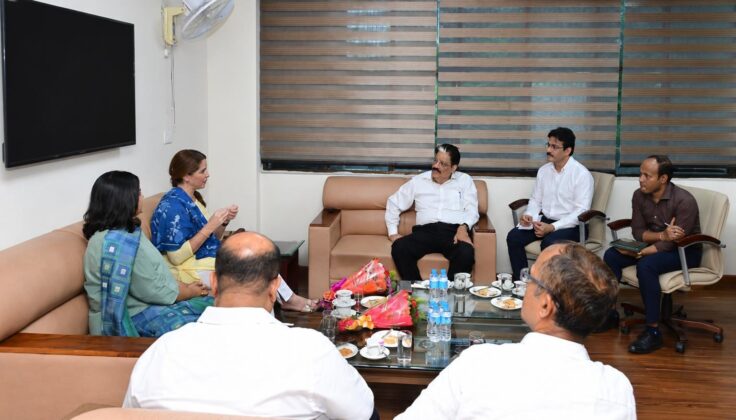
High-level meeting between State Policy Commission and UNICEF
Developed Chhattisgarh and Bastar Anjor got international support
Raipur, June 17, 2026: A high-level delegation from UNICEF India paid a courtesy call on Shri Ganesh Shankar Mishra, Vice Chairman of the Chhattisgarh State Policy Commission, today at NITI Bhawan, Nava Raipur. The delegation was led by Ms. Soledad Herrero, Field Service Chief, UNICEF India. Mrs. Seema Kumar, Chief of the UNICEF Chhattisgarh Field Office, and Dr. Bal Paritosh Dash, Chief of Social Policy, were also present.
In the meeting, there was a detailed discussion on the developed Chhattisgarh Pragati Framework, Child Welfare Index, Public Finance for Children, Community Awareness and Social Behaviour Change and Bastar Anjor Programme.
Developed Chhattisgarh – Where children are the foundation of development
At the meeting, State NITI Aayog Vice Chairman Mr. Mishra clarified that in the vision of a developed Chhattisgarh, children are not just beneficiaries but the foundation of the state's development. He stated that the goal of a developed Chhattisgarh is incomplete until every child in the state is assured of health, nutrition, education, and protection. The State NITI Aayog has developed key performance indicators for more than 50 departments under the Developed Chhattisgarh Progress Framework, which includes child welfare as an independent and dedicated area.
Chhattisgarh Social Policy Support Unit developed, a bridge between policy and ground
The VC-SPS Unit, a joint effort of the State Policy Commission and UNICEF, is a key institutional initiative towards evidence-based policymaking in the state. The unit provides ongoing technical support to state departments on the development of the Chhattisgarh Progress Framework, the Child Wellbeing Index, budget analysis for children, and strengthening social protection. The meeting commended the work of this unit and agreed to further strengthen it.
For the first time in the country – Child Wellbeing Index
For the first time in the country, the State Policy Commission will develop a state-specific child well-being measurement system and a child deprivation index. This index will help state departments identify gaps in service delivery to children and strengthen child-centered policies. A standardized budgeting framework for children will also be developed. The UNICEF delegation commended this proposed initiative, stating that it would serve as a model to be replicated at the national level.
Bastar Anjor – A historic opportunity for tribal and child development
The meeting highlighted Bastar Anjor as a groundbreaking opportunity for the welfare of tribal communities and children. This innovative coordination initiative, spearheaded by the State Policy Commission, covers all seven districts of the Bastar division. Based on the 3+4 model, the program integrates three collector-led district initiatives—Niyad Nella Nar, Bastar Munne, and Swasth Bastar—with four national and state missions. Over 90 percent of the program's intervention areas relate to child health, nutrition, and social protection.
UNICEF described this event as a rare and important opportunity to bring the light of development to a conflict-affected area and gladly accepted to participate as the Chief Guest and Strategic Partner in the formal inauguration of Bastar Anjor.
Community awareness, trust building and social behaviour change
The meeting emphasized that the success of government schemes is determined not only by policy and budget, but also by community trust and behavioral change. Building community awareness and public trust is a prerequisite for development in tribal and conflict-affected areas like Bastar.



.jpeg "A New Milestone in Good Governance : CM Helpline Becomes the Voice of the People, Over 92,000 Complaints Registered and More Than 42,000 Grievances Resolved in Just One Month,48 Government Departments on a Single Platform; Raipur Leads Among Districts, Energy Department Tops in Grievance Redressal")